
A man who wanted everyone to read the Bible
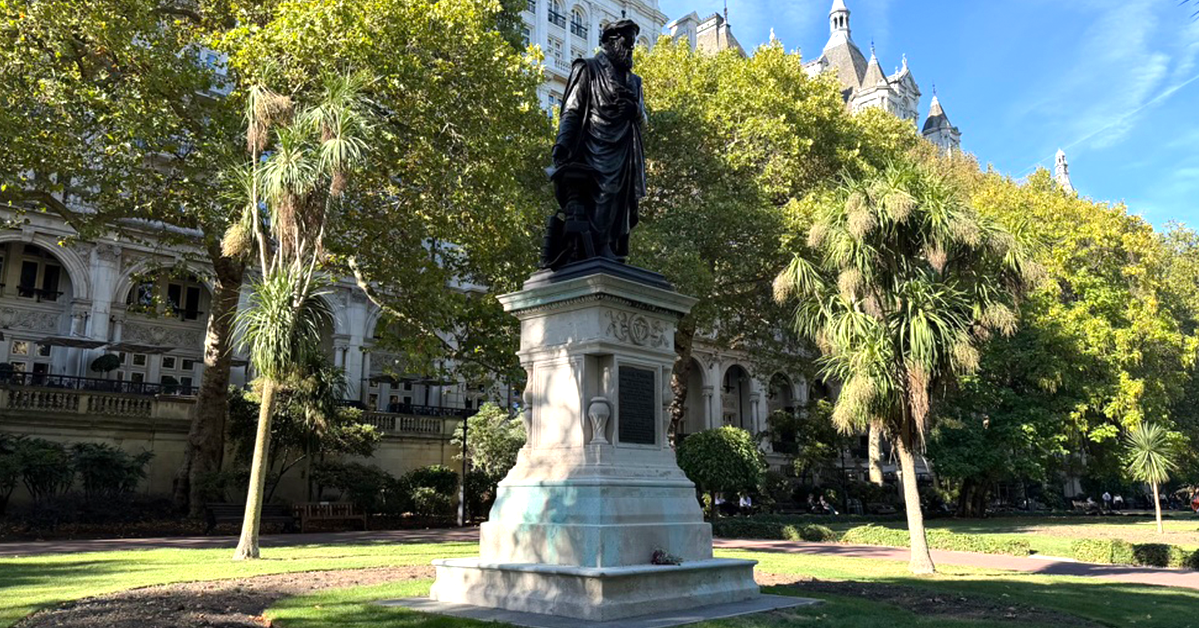
William Tyndale was born around 1494 in Gloucestershire, England. He died 6 October 1536 so this week is the aniversary of his death.
He studied at Oxford and is also associated with Cambridge, becoming an accomplished scholar of Greek and Hebrew.
But Tyndale was increasingly troubled by something. The religious system of his day claimed authority over the Scriptures, yet ordinary people were unable to read those Scriptures for themselves.
The Bible was available primarily in Latin, a language most people did not understand.
Tyndale believed that the Word of God should be accessible to everyone.
He is famously reported to have told a clergyman:
“I will cause a boy that driveth the plough shall know more of the Scripture than thou dost.”
It was a revolutionary ambition.
Tyndale wasn't simply interested in translating a book. He wanted ordinary people to be able to examine the claims of the religious establishment against the actual words of Scripture.
And that was dangerous.
In 1523, Tyndale travelled to London.
During his time in London, Tyndale preached at St Dunstan-in-the-West, on Fleet Street, where he is recorded as having lectured. Around this time the first printing presses in England were being used in Fleet Street which later became famous for the news paper presses and businesses which developed from there.
Tyndale had a revolutionary idea. Why couldn’t this new technology be used to print God’s word in English so that everyone could read it? At the Eastern end of Fleet Street stands the Cathedral of St Paul’s. It has been rebuilt since those days but it was still one of the main Cathedrals in London. It was run by, Cuthbert Tunstall, the Bishop of London.
Tyndale requested support from Tunstall to complete his translation and get it printed. No support was forthcoming.
Eventually, Tyndale realised that he would not be able to complete his work safely in England. In 1524, he left the country.
He would never return.
The contraband Bible that came into England in secret
Almost 150 years earlier, John Wycliffe and his followers had produced an English Bible, but their translation was based on the Latin Vulgate, itself a translation of earlier biblical texts. Such was the hostility towards Wycliffe that, in 1428, some 44 years after his death, Church authorities had his bones dug up, burned and his ashes scattered into a river. His challenges to Church doctrine and authority had made him a condemned heretic.
By Tyndale's time, however, something remarkable had happened.
During the fifteenth century, Greek scholars and manuscripts had increasingly made their way from the Byzantine East into Western Europe. This movement accelerated around the fall of Constantinople to the Ottoman Turks in 1453, helping fuel a revival of Greek learning.
Then, in 1516, the great Renaissance scholar Erasmus published a printed edition of the Greek New Testament.
For the first time, scholars such as Tyndale had relatively easy access to a printed Greek text from which they could translate.
An attempt to print it in Cologne in 1525 was interrupted, but in 1526 a complete printed edition appeared in Worms, Germany.
It was a historic achievement.
For the first time, English readers could obtain a printed New Testament translated directly from the Greek. But there was a problem.
The Catholic church authorities in England did not want it. Copies were smuggled into the country, concealed among ordinary merchandise.
Imagine the scene. A merchant arrives at an English port. Hidden among his goods are small books containing the words of Jesus Christ, the apostles and the Gospel.
These books were considered so dangerous that the authorities wanted them seized and destroyed. Why?
Because once people could read the Bible for themselves, they could begin questioning whether the teachings and practices of the Church were actually supported by Scripture.
This brings to mind the words from Hebrews 4:
“For the word of God is quick, and powerful, and sharper than any twoedged sword.” Hebrews 4:12
The authorities understood that the Scriptures possessed a power that threatened their control.
The burning of the Bibles at St Paul's
The Bishop of London, Cuthbert Tunstall, became one of the leading opponents of Tyndale's translation.
Copies of the English New Testament were collected and publicly burned at Old St Paul's Cathedral. Hundreds of books were destroyed by St Paul’s cross in the north eastern courtyard of the Cathedral. A spot you can still visit today.
The intention was clear: suppress the translation, intimidate its readers and prevent the Scriptures from circulating. Protect the church’s authority at the expense of the truth of scripture.
There is a remarkable story associated with these events.
Tunstall is said to have purchased copies of Tyndale's New Testament so that they could be burned. But the money paid for those books helped fund the printing of additional, better quality, copies!
In trying to destroy the English Bible, its opponents were inadvertently helping to finance its distribution.
And five hundred years later, here we are. The modern St Paul's Cathedral is exhibiting one of the three surviving copies from Tyndales first translation. It is difficult to imagine a more striking reversal!
Those who condemned Tyndale have largely been forgotten by the general public.
Yet his translation continues to influence the English language and the way millions of people read Scripture.
It reminds us of Isaiah's words:
“The grass withereth, the flower fadeth: but the word of our God shall stand for ever.” Isaiah 40:8
Kings, bishops, empires and institutions come and go.
But the Word of God remains.
Tyndale's betrayal and death
Tyndale spent the remainder of his life on the European continent, continuing his work.
He translated portions of the Old Testament and worked to make Scripture available to English readers.
But in 1535, while living in Antwerp, he was betrayed by a man named Henry Phillips.
Tyndale was arrested and imprisoned at Vilvoorde Castle, near Brussels. He remained in prison for more than a year.
In October 1536, he was executed. He was strangled and his body burned.
His final words are traditionally recorded as:
“Lord, open the King of England's eyes.”
Tyndale died without seeing the full consequences of his work. But within just a few years, the situation in England had changed dramatically. In 1539, the Great Bible was authorised for use in English churches. And in 1611, the King James Version appeared, drawing heavily on Tyndale's pioneering translation.
The man who had been executed for translating the Scriptures had helped lay the foundations for the English Bible that would become familiar to generations.
The two witnesses of Revelation 11
For those of us study Bible prophecy, Tyndale's story forms part of a much larger picture.
In the symbolic book of Revelation - which recounts God’s work amongst the nations from John’s time until now and beyond - we read of Tyndales time in chapter 11:
“And I will give power unto my two witnesses, and they shall prophesy a thousand two hundred and threescore days, clothed in sackcloth.” Revelation 11:3
The passage describes witnesses who testify under conditions of intense hatred and oppression. Their testimony is opposed by powerful apostate enemies.
The 1,260 days represent 1,260 years, using the prophetic day-for-a-year principle (illustrated in passages like Numbers 14:34 and Ezekiel 4:6).
We understand this period is understood to relate to the long centuries of the dark ages, during which ecclesiastical power, centred upon Rome, dominated much of European religious life.
The two witnesses have been understood as representing bodies of people who resisted the corruptions of the established religious and political systems.
“And their dead bodies shall lie in the street of the great city, which spiritually is called Sodom and Egypt, where also our Lord was crucified.” Revelation 11:8
William Tyndale’s story illustrates the conflict between corrupt religious authority and the testimony of Scripture that we see reflected in the prophecy.
He challenged an institution that claimed religious authority. He sought to restore access to the Word of God. He suffered persecution. And ultimately, he was killed. But his testimony was not silenced.
That great city was the city of Rome. Tyndale’s is one of the dead bodies laying in its symbolic street.
From England to the ends of the earth
There is another extraordinary aspect to this history.
The English language eventually became one of the most widely used languages in the world.
Through trade, migration, the expansion of the British Empire and the work of Bible societies, English Bibles travelled across continents. The protestent reformation, with its cry of “sola scriptura” (the Bible alone) continued Tyndales legacy.
In 1804, the British and Foreign Bible Society was founded, helping to distribute Scripture and support translations into many languages.
One consequence of Britai n's global influence was the enormous international distribution of the Bible.
A translation that had once been smuggled into England under threat of confiscation eventually helped shape a worldwide tradition of English Bible reading and the protestent culture. A culture which is now largly forgotten.
For believers in God's providence, that is a remarkable development.
It is worth considering the words of Isaiah:
“So shall my word be that goeth forth out of my mouth: it shall not return unto me void.” Isaiah 55:11
And then this passage in Jeremiah
“Hear the word of the LORD, O ye nations, and declare it in the isles afar off, and say, He that scattered Israel will gather him, and keep him, as a shepherd doth his flock.” Jeremiah 31:10
The human authorities of Tyndale's day tried to prevent the Scriptures from reaching ordinary people. Yet the Bible continued to spread. The British people did once hear in their isle afar off and the influence of the word of God caused the British to be heavily involved in the restoration of the Jews back to their ancestral homeland.
Tragically the Bible is now often critisized without a page of it being read. Modern English Society is ignorant of the truth of the words Tyndale gave his life to bring to their attention.
The rediscovery of Bible truth
This brings us to a development particularly relevant to Christadelphians.
In 1805, John Thomas was born in London. In 1832, he emigrated to America.
During the Atlantic crossing, his ship encountered a severe storm, an experience that prompted him to consider his relationship with God and to begin studying the Bible seriously.
Over the following years, Thomas questioned many of the established religious teachings of his time.
He became convinced that the Christianity of the first century had been obscured by centuries of tradition. Rather than accepting the doctrines of existing denominations, he sought to establish his beliefs directly from Scripture.
His studies eventually led to the publication of Elpis Israel in 1848. Through John Thomas and those who shared his conclusions, the beliefs that would become associated with the Christadelphian community took shape.
Consider the historical connection. Tyndale had given his life so that ordinary English-speaking people could read the Scriptures. Three centuries later, John Thomas was able to study the Bible independently, throw off religious tradition and develop an understanding of the Gospel of salvation.
Tyndale’s work contributed to the wider historical circumstances in which independent Bible study became increasingly possible. And that is something worth reflecting upon.
What does this mean for us?
There is a danger in looking back at William Tyndale and simply admiring his courage. We can be impressed by his scholarship. We can be moved by his martyrdom. We can marvel at the survival of his translation.
But the most important question is what we do with the Bible today.
Tyndale risked everything because he believed people needed access to the Word of God.
He wanted the ploughboy to know the Scriptures. He wanted people to test religious claims against the Bible. He wanted God's Word to speak for itself.
And today, we have access to that Word in ways Tyndale could scarcely have imagined.
We have printed Bibles, study tools, concordances, digital libraries and translations available at the touch of a button. Yet having access to the Bible is not the same as understanding it. Nor is understanding it the same as allowing it to shape our lives.
The apostle Paul was inspired to write to Timothy:
“And that from a child thou hast known the holy scriptures, which are able to make thee wise unto salvation through faith which is in Christ Jesus.” 2 Timothy 3:15
That is the real significance of the Scriptures. They are not simply a remarkable historical document. They are able to make us wise unto salvation. But we need to read them. And seek to understand them.
The words they could not destroy
Five hundred years ago, the authorities burned English New Testaments at St Paul's Cathedral.
They believed they could suppress the Scriptures by destroying the books and persecuting those responsible for translating them.
William Tyndale paid for his work with his life.
But his translation survived. The English Bible spread. The religious monopoly that had sought to suppress it was weakened. And over the centuries, countless people gained the opportunity to study the Scriptures for themselves.
Today, one of Tyndale's surviving New Testaments sits on display at St Paul's.
The very institution that once opposed his work now commemorates it. The irony and the wiff of hypocrasy is not missed.
And perhaps the greatest tribute we can pay to William Tyndale is not simply to remember his sacrifice. It is to do what he wanted ordinary people to do.
Open the Bible. Read it. Question what we have been taught. And discover the truth of God's Word for ourselves.
As Peter wrote:
“But the word of the Lord endureth for ever.” 1 Peter 1:25
And five hundred years after Tyndale's New Testament, that remains as true as ever.
This has been Matt Davies joining you for this weeks Bible in the News. Come back next week as we continue to watch current events in the light of Bible prophecy.